Introduction
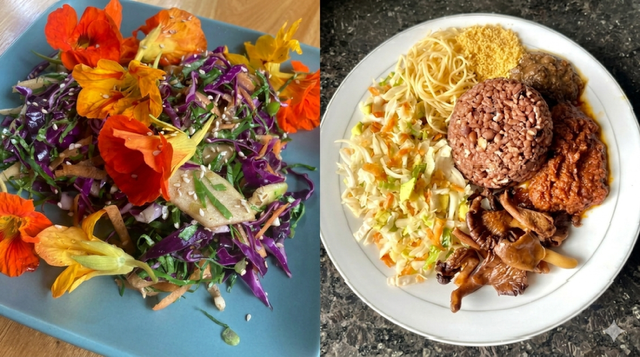
Take a look at these two elegantly plated dishes below. The first is a vibrant plate of salad, garnished with colorful edible flowers and topped with sesame seeds. You can tell this salad is made with “love,” as my five-year-old daughter likes to say. The second is a plate of waakye (rice mixed with beans), one of Ghana’s beloved street foods, accompanied with coleslaw, spaghetti, gari(cassava granules), spicy sauce, and fried oyster mushrooms. If you are Ghanaian, which plate would you naturally gravitate towards?
The Healthy Eating Community
One challenge within the “healthy diet” community is how dietary choices are sometimes communicated. What begins as personal lifestyle decision can occasionally come across as moral superiority or quiet judgment toward others. In extreme cases, some people view their preferred diets not just as choices, but as a measure of who is considered worthy of living on this green earth. (I hope those who know me or my work don’t lump me in with the more “annoying” members of the healthy eating community.)
To get straight to the point, As a vegan who prioritizes indigenous food and lays emphasis on culturally appropriate cuisine, I sometimes get astounded by how some Ghanaian vegans or vegetarians present themselves to the public.
A typical example: as a member of about five groups (both local and international groups) that promote a healthy and sustainable lifestyle.
One thing I have noticed on my local network is that most members of Ghanaian heritage constantly post food that looks nothing like a Ghanaian palate. Let me throw in this hilarious comment from a member in one of my groups: “Please let me ask ooo, is this a bouquet or food?” — a question she asked under a post by another member showing a colorful and inviting plate of salad garnished with different varieties of edible flowers. (first dish above)
I’m not saying people aren’t allowed to explore other diets. The issue is that once some people adopt a cleaner diet and/or become vegan or vegetarian, they gradually or immediately throw out their cultural food and lean towards a more foreign-ingredient-centred diet — which, by the way, is not easy to find and also expensive.
Such people also like to post recipes with ingredients they can’t pronounce or might never see in their lifetime. And then turn around to call people who can’t recognize or consume such foods “villagers” (unsophisticated).
Also, in Ghana, it is uncommon to see a typical Ghanaian eating a solo bowl of salad or soup. If they do have some vegetables, it will likely be less than a handful on a plate of waakye or jollof they buy outside or prepare at home. Not many Ghanaians can relate to communities whose content is entirely about salads.
With the soup situation, give a bowl of soup to a regular Ghanaian and they will ask you where the fufu, banku, akpele or TZ is. Why? Because it is culturally inappropriate to eat just soup as a meal on its own.
Another disturbing thing about some healthy dietary communities, especially some vegans, is that they see regular food consumers as terrible people who eat animals for food. It may or may not shock you to know that some vegans would not even associate with non-vegans.
This brings me to the public misconception about veganism being a cult. If you go around trumpeting how sacred your diet is and try to demonize or distance yourself from the rest of society, who consume meat, what kind of perception do you expect from the public?
Personal Example
As a practicing Muslim and a vegan, per my dietary ethics, animals should not be consumed as food, used for products, offered as religious sacrifices, or maltreated. But this does not give me the moral license to go around asking my family or community not to sacrifice animals as required by Islamic rituals. In fact, I would be considered “crazy” if I tried that.
I can imagine the response I would probably receive from one of my cousins if I tried to talk them out of eating meat. It might sound something like: “You, whose diet is for sick people, and you have the audacity to tell us meat is not good.” (You might need to read this in a Ghanaian accent to get the hilarious kick.)
I also understand that animal protein is a big part of Ghanaian gastronomy — so whether I like it or not, I’m always going to see family, friends, and other people eat meat in my presence, which I have to understand and tolerate, just as I would tolerate another person’s religion or political views.
Call to Action
It is our duty, as people like me who choose to consume sustainable and healthy food alternatives, to educate regular dieters about the health benefits of consuming an eco-friendly diet, as well as the impact it has on the environment.
Also, we must try as a healthy eating community to include and creatively use local ingredients in our dishes so that other non-vegans and non-vegetarians can be encouraged to do the same.
We must also learn to tolerate the dietary views of people who don’t subscribe to our way of eating.
Conclusion
Trust me! even within the healthy eating communities (be they vegan or vegetarian) there is a never-ending intra-group conflict about whose diet is the right one or considered a truly plant-based diet.
Well, for me, as long as my food provides all necessary nutrients, doesn’t cause others to raise their eyebrows, and my grandmother or any Ghanaian can recognize the food in my bowl — be it an innovative and reimagined TZ, banku, or meat — I’m good with it. Because it checks and fulfils the requirements of food being culturally appropriate, available, and accessible, as stipulated in international law on the right to food.
Glossary
Vegan — A person whose diet consists of vegetables and fruits and completely excludes any form of animal protein. Note: Veganism goes beyond abstaining from eating animal flesh.
Vegetarian — A person whose diet consists of vegetables, fruits, eggs/fish/milk but excludes meat.
Disclaimer
The views expressed in this article are solely those of the author and do not necessary reflect the perspectives of other healthy food communities within or outside of Ghana.
Author: Hawa Mutawakilu (Food Writer, Vegan Chef and Sustainability Advocate)